
Principis Group Weekly BWC Governance Recap


Several recent developments illustrate how body-worn camera footage continues to shape investigations, legal review, and public understanding of police incidents.
In California, investigators are reviewing body-worn and dashboard camera footage following a police shooting in Santa Rosa during a confrontation with a suspect reported as acting aggressively. The footage is expected to be central to determining how the encounter unfolded. https://www.sfchronicle.com/crime/article/santa-rosa-police-shooting-22073808.php?utm_source=chatgpt.com
In Hartford, Connecticut, body-camera recordings from a police shooting involving a man experiencing a mental health crisis have prompted analysis from law-enforcement experts and renewed discussion about de-escalation strategies and response models. https://www.ctinsider.com/news/article/hartford-police-shooting-video-blue-hills-ave-21958869.php?utm_source=chatgpt.com
Meanwhile, newly released body-camera video from a fatal federal agent shooting in Texas has raised questions about earlier official descriptions of the event, highlighting how footage can alter public understanding once it becomes available. https://apnews.com/article/e7377deeae6ba9a42a31b7b03da14598?utm_source=chatgpt.com
Taken together, these cases illustrate the central role body-worn camera recordings now play in reconstructing events, informing investigations, and shaping public narratives. Though not implicit in the articles, empashizes the importance over solid governance practices in place before an incident occurs, rather than after.
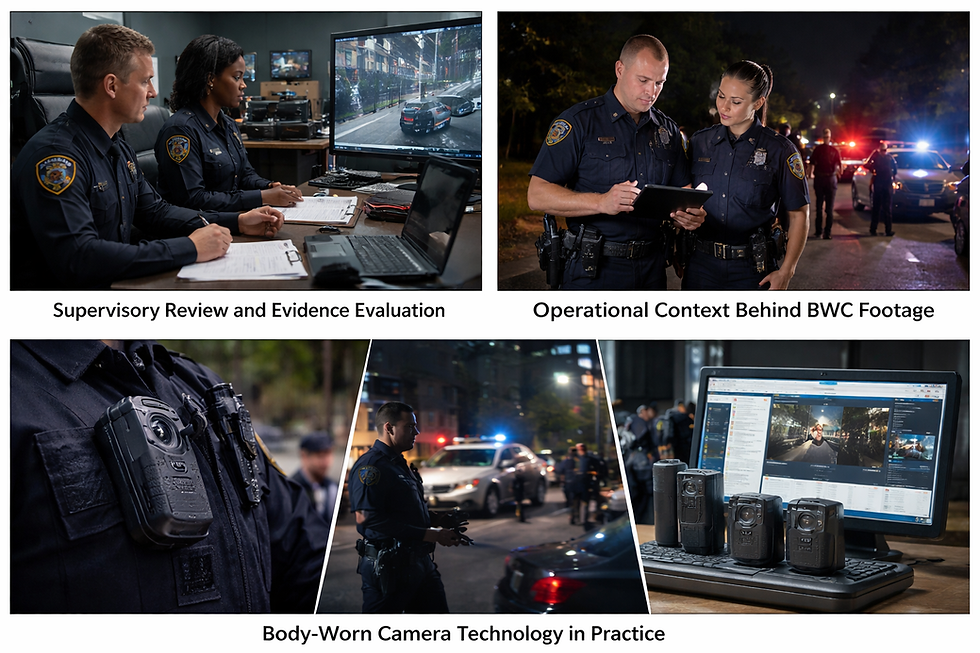
Supervisory Review and Evidence Evaluation
Across many of this week’s incidents, body-camera recordings quickly became the primary source used to understand what occurred.
However, the presence of video alone does not resolve an investigation. Supervisors and investigators must still evaluate footage within a broader evidentiary framework that includes officer statements, dispatch records, witness accounts, and physical evidence.
This is where governance becomes essential. Structured supervisory review converts raw footage into a documented evidentiary record. Clear protocols defining who reviews footage, when it is reviewed, and how findings are documented are critical components of responsible body-camera oversight.
Operational Context Behind BWC Footage
Lighting conditions, camera angle, movement, and activation timing can all influence how an event appears when reviewed later. As a result, responsible analysis requires integrating footage with other sources of information.
Without that broader context, even clear video can provide only a partial picture of the event.
Body-Worn Camera Technology in Practice
The week’s events also reinforce a broader operational reality: body-worn cameras are now embedded in nearly every stage of modern policing—from incident documentation to investigative review.
However, cameras themselves do not resolve governance challenges. Agencies must still address policy clarity, activation expectations, supervisory review processes, documentation standards, and release protocols.
Cameras record events. Governance determines how those recordings are interpreted, preserved, and relied upon.
Governance Takeaways
Several operational lessons emerge from this week’s developments:
Video frequently becomes the central evidentiary record in critical incidents.
Supervisory review is essential to interpret footage within the proper context.
Body-camera recordings capture perspective, not the entire operational environment.
Clear documentation and review protocols strengthen investigative defensibility.
Body-worn cameras remain one of the most influential transparency tools in modern policing. Their value, however, ultimately depends on structured policy, disciplined supervisory oversight, and clearly defined governance processes.
About Principis Group
Principis Group provides governance-focused advisory, assessment, and training services supporting defensible, sustainable body-worn camera programs nationwide.


Comments